Call 01483 459 659 or email uk.enquiries@enovis.com for assistance.
Alternatively, complete the form below and our team will be in touch.
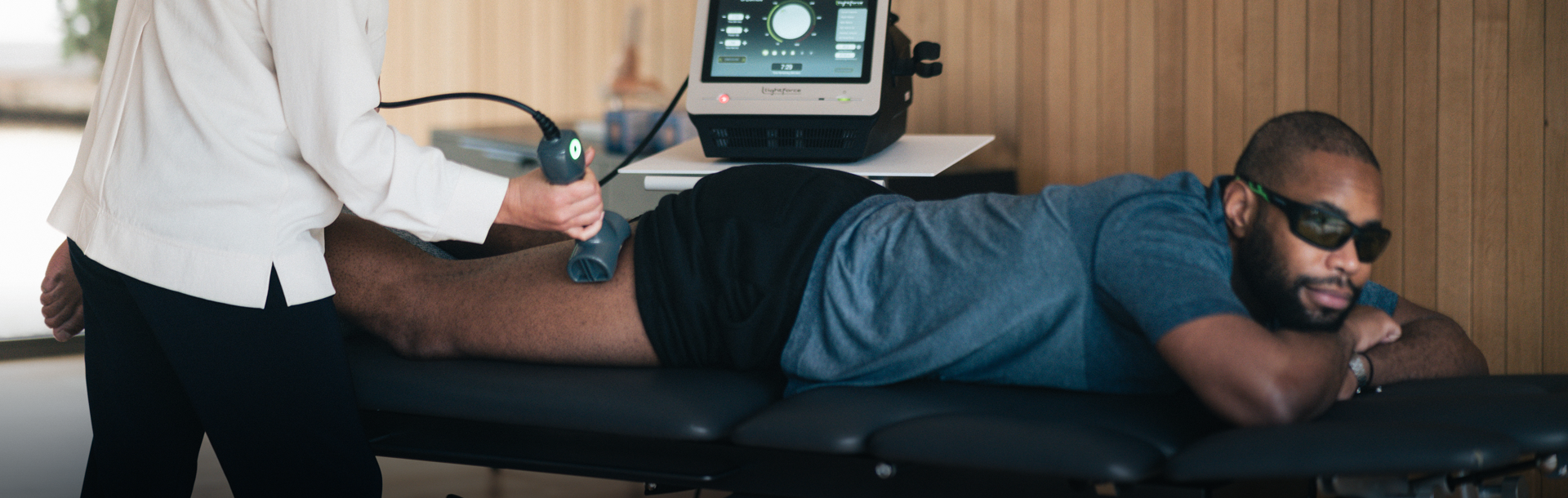
Laser therapy, also known as photobiomodulation (PBMT), is a safe and effective tool for musculoskeletal injury management, pain relief, and tissue repair. As clinicians explore incorporating laser therapy into their practice, we often hear questions about wavelength, pulsing, device power, and compatibility with other treatments.
Here, we answer the most frequently asked questions to help you understand how LightForce® laser therapy works and why it may benefit your patients.
There is no single “magic” wavelength for laser therapy. The target cellular enzyme, Cytochrome C, responds to a broad spectrum of light ranging from 600nm to 1064nm and beyond.
The key to effective therapy is delivering the light to the tissue with sufficient power. Clinically, blending 810nm and 980nm wavelengths – adjusted for skin color and other parameters – has been shown to be the most effective and well-researched approach for triggering photobiomodulation.
Some devices advertise “superpulsing,” which uses pulse durations in the microsecond (10⁻⁶ s) or nanosecond (10⁻⁹ s) range. However, research shows these extremely short pulses do not optimally trigger photobiomodulation.
According to Hashmi (2010, Effect of Pulsing in Low-Level Light Therapy), the most effective laser emission for PBMT must be continuous or pulsed with durations of at least a few milliseconds (10⁻³ seconds).
LightForce therapy is extremely safe for most conditions. The only commonly observed effects are:
These effects are short-lived, typically lasting a few hours. Proper dosing and the use of the Smart Handpiece help minimize these temporary changes.
Older devices – often called Cold Laser, Low-Level Laser Therapy (LLLT), or Low-Intensity Laser Therapy (LILT) – deliver very low power (<0.5W for Class IIIb lasers).
LightForce® Class IV lasers are not limited by these constraints, offering:
This makes treatments quicker and more effective, improving patient outcomes.
Yes. LightForce therapy works well with other tissue repair modalities, such as shockwave therapy, which can complement its biological effects.
However, modalities that reduce blood flow, such as cryotherapy, are generally not recommended as adjuncts with LightForce, since they may counteract the therapy’s mechanism of increasing circulation.
If you want to offer your patients faster recovery, reduced pain, and improved function, photobiomodulation therapy is a modern, clinically proven solution.
👉 Schedule a demonstration today to see how LightForce® can enhance your practice: Book by clicking HERE
🔗 Download our Laser Therapy E-Book for a deep-dive into the science: Download HERE
References:
Alternatively, complete the form below and our team will be in touch.